The world of inorganic NMR
Last updated:
29/05/26, 18:38
Published:
04/06/26, 08:00
NMR is far more elementally diverse and is applicable to any nucleus with a spin quantum number (I) greater than 0
Introduction
“It’s an organic chemist’s world, and we are just living in it” is my take on a popular idiom which has never felt more relevant than in the context of NMR spectroscopy. Since our first introductions to nuclear magnetic resonance (NMR), we are often led to believe that the technique is only applicable to proton (¹H) and carbon (¹³C) nuclei. However, NMR is far more elementally diverse and is applicable to any nucleus with a spin quantum number (I) greater than 0.
This article will introduce fluorine (¹⁹F) and phosphorus (³¹P) NMR spectroscopy before considering the “satellite spectra” that arise from nuclei that are not 100% naturally abundant. Finally, the article will explore quadrupolar nuclei, proving that NMR extends far beyond the constraints of organic chemistry.
Phosphorus and Fluorine
Before discussing ¹⁹F and ³¹P NMR spectroscopy, it is worth considering how a ¹H NMR spectrum is used to characterise a molecule. First, the chemical shifts of particular protons depend on their electronic environments, with protons surrounded by more electronegative elements appearing athigher chemical shifts as they interact more strongly with the applied magnetic field. Splitting patterns are determined by the number of neighbouring nuclei and follow the 2nI + 1 rule, where n is the number of neighbouring nuclei and I is the spin quantum number of the coupled nucleus. Peak intensities are predicted by Pascal’s triangle.
These rules are applicable to any spin‑½ nuclei, including ³¹P and ¹⁹F. For example, the inorganic anion [PF₆]⁻ is frequently used as a stabilising counterion in many cationic inorganic complexes and can be readily characterised using NMR.
Considering the ³¹P NMR spectrum first, the phosphorus nucleus couples to six equivalent ¹⁹F nuclei and therefore produces a septet splitting pattern. Alternatively, in the ¹⁹F NMR spectrum, six equivalent fluorine nuclei couple to one ³¹P nucleus, producing a doublet.
Satellite Spectra
The term “satellite spectra” arises when considering coupling to spin‑active NMR nuclei that are not 100% naturally abundant. This usually occurs because multiple isotopes of an element exist, but only one is NMR‑active. For example, tungsten has five naturally occurring isotopes, but only one is NMR‑active (¹⁸³W), with a natural abundance of 14.3%.
To illustrate how this affects the appearance of an NMR spectrum, consider the compound trans‑[W(PPh₃)₂(CO)₄], where the two triphenylphosphine ligands are chemically equivalent. We would initially expect a singlet in the ³¹P NMR spectrum.
However, the ³¹P nuclei can also couple to the tungsten centre. Rather than observing a simple doublet, the spectrum appears as a singlet with a small superimposed doublet. This occurs because 85.7% of the molecules contain an inactive tungsten isotope, while 14.3% contain ¹⁸³W.
Quadrupolar Nuclei
NMR spectra can also be obtained for nuclei with spin quantum numbers where I ≥ 1, known as quadrupolar nuclei. While less commonly analysed by NMR, quadrupolar nuclei account for over 70% of the NMR‑active nuclei on the periodic table.
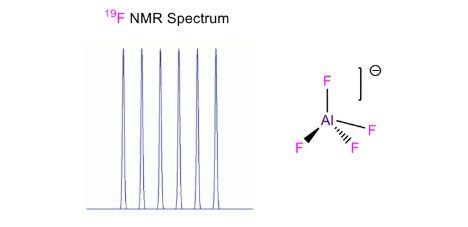
An example of where quadrupolar NMR spectroscopy is effective is in studying the tetrafluoroaluminate ion, [AlF₄]⁻. The ¹⁹F NMR spectrum of this compound appears as a sextet with equal line intensities, as quadrupolar nuclei still obey the 2nI + 1 rule. The splitting pattern indicates that the ²⁷Al nucleus has a spin quantum number of 5/2, and the peak intensities are no longer governed by Pascal’s triangle.
However, quadrupolar nuclei are not commonly studied by NMR because their non‑spherical charge distributions often lead to extensive peak broadening. [AlF₄]⁻ acts as a useful exception, where the peaks resolve because of the symmetry in a tetrahedral geometry. Quadrupolar NMR is therefore most effective in highly symmetric environments, such as octahedral (Oₕ) and tetrahedral (T_d) geometries.
Conclusion
In conclusion, the elemental diversity of NMR spectroscopy makes it one of the most powerful characterisation techniques available to a synthetic chemist. While this article has focused on inorganic applications of NMR, the scope of the technique is far broader. From using NMR to investigate molecular diffusion to advanced 2D NMR methods including COSY and NOESY, NMR spectroscopy dominates the analytical landscape like few others.
Written by Antony Lee
Related articles: Advances in mass spectrometry technology
Project Gallery
![Figure 1- 31P and 19F NMR spectra of [PF6]-
illustrating that the predicted splitting patterns follow the same rules as
1H NMR spectroscopy.](https://static.wixstatic.com/media/229b1c_5f31cbd2759549c7af811a52f604c796~mv2.jpg/v1/fill/w_631,h_586,q_90,enc_avif,quality_auto/229b1c_5f31cbd2759549c7af811a52f604c796~mv2.jpg)
![Figure 2- 31P NMR spectrum of trans [W(PPh3)2(CO)4] with the relative intensities of each each peak determined by their natural abundances.](https://static.wixstatic.com/media/229b1c_2b4001e08287432e95d6ec65607cdc4b~mv2.jpg/v1/fill/w_570,h_369,q_90,enc_avif,quality_auto/229b1c_2b4001e08287432e95d6ec65607cdc4b~mv2.jpg)